November 10, 2026
How Precision Pipe Bending Enhances Automotive Performance and Safety

Team Pipe Processing
Every vehicle depends on tubing. Exhaust systems carry hot gas away from the engine, fuel lines deliver fuel under pressure, and brake, coolant, and hydraulic lines keep other systems working. The geometry of those tubes affects how well the vehicle runs and whether it stays safe over years of vibration, heat, and road conditions.
Precision pipe bending controls that geometry. A bend that is accurate, smooth, and repeatable fits the vehicle, flows well, and lasts. A poor bend can restrict flow, weaken the tube, or fail early. This guide explains how bending quality affects performance and safety, and what to specify when you source bent tube for automotive parts.
Why Bend Quality Matters in Automotive Systems
Bending changes the tube. The outside wall stretches and thins, and the inside wall compresses. If the process isn't controlled, that can cause:
- Wrinkling on the inside of the bend, which disrupts flow and creates weak points
- Ovality or flattening, where the round cross-section becomes oval and reduces flow area
- Excessive wall thinning on the outside of the bend, which lowers strength and pressure capacity
- Kinking on tight radii, which can block a line almost completely
Each of these affects both performance and safety, as the next sections show.
How Precision Bending Improves Performance
Better flow in exhaust systems
Exhaust gas flows best through smooth, round, consistent tubing. Wrinkles, flattened sections, and abrupt geometry change add restriction and turbulence, which raises backpressure. Smooth mandrel-supported bends hold the full internal diameter through the curve, so the system flows as designed. That matters for engine efficiency, and it matters for emissions systems where the layout is engineered around specific flow conditions.
Accurate fit and packaging
Under a vehicle, space is tight. Exhaust and fuel lines run past the chassis, suspension, heat shields, and other components with very little clearance. Bend angle, centerline radius, and straight lengths between bends all have to match the design, or the part won't fit, or it fits under stress. Stressed installation loads mounts and joints, so parts loosen, rattle, or crack.
Consistent bending also matters for production. When every part in a run of thousands matches the drawing, assemblies go together without rework, and the same part behaves the same way on every vehicle.
Fewer joints, lower weight
A single bent tube can replace several straight sections joined by welds or fittings. That means fewer parts, lower weight, and less assembly time.
How Precision Bending Improves Safety
Fewer leak points
Every weld or fitting in a fuel or fluid line is a possible leak point. Fuel leaks are a fire risk, and exhaust leaks can let hot gas and carbon monoxide escape near the vehicle. Bending a line as one continuous piece removes joints, and pressure testing confirms the finished part is leak-free before it ships.
Strength under vibration and heat
Vehicle tubing works under constant vibration and repeated heating and cooling. Cracks tend to start at stress concentrations, such as wrinkles, kinks, or areas where the wall has thinned too much. Controlled bending keeps wall thickness within limits and avoids those defects, which extends the life of the part and lowers the chance of a fatigue failure.
Reliable fuel delivery
A kinked or flattened fuel line restricts flow. Even a partial restriction can affect engine performance, and a damaged line can fail under pressure. Smooth bends with the correct radius protect the internal diameter and the wall.
The Tolerances That Matter
When you specify bent tube for automotive use, these are the values to define on the drawing:
| Tolerance | Why it matters |
|---|---|
| Bend angle | Determines fit and alignment with mating parts |
| Centerline radius | Affects flow, wall thinning, and whether the tube will form without wrinkling |
| Ovality and wall thinning limits | Protect flow area and strength |
| Straight length between bends | Ensures clearance and correct connection points |
| Overall dimensional accuracy | Confirms the finished part matches the assembly |
Tighter tolerances are not always better. They add cost, so specify the tightness the application actually needs, and be strict on the features that affect fit, flow, and safety.
Choosing the Right Bending Method
The right method depends on material, wall thickness, bend radius, and volume.
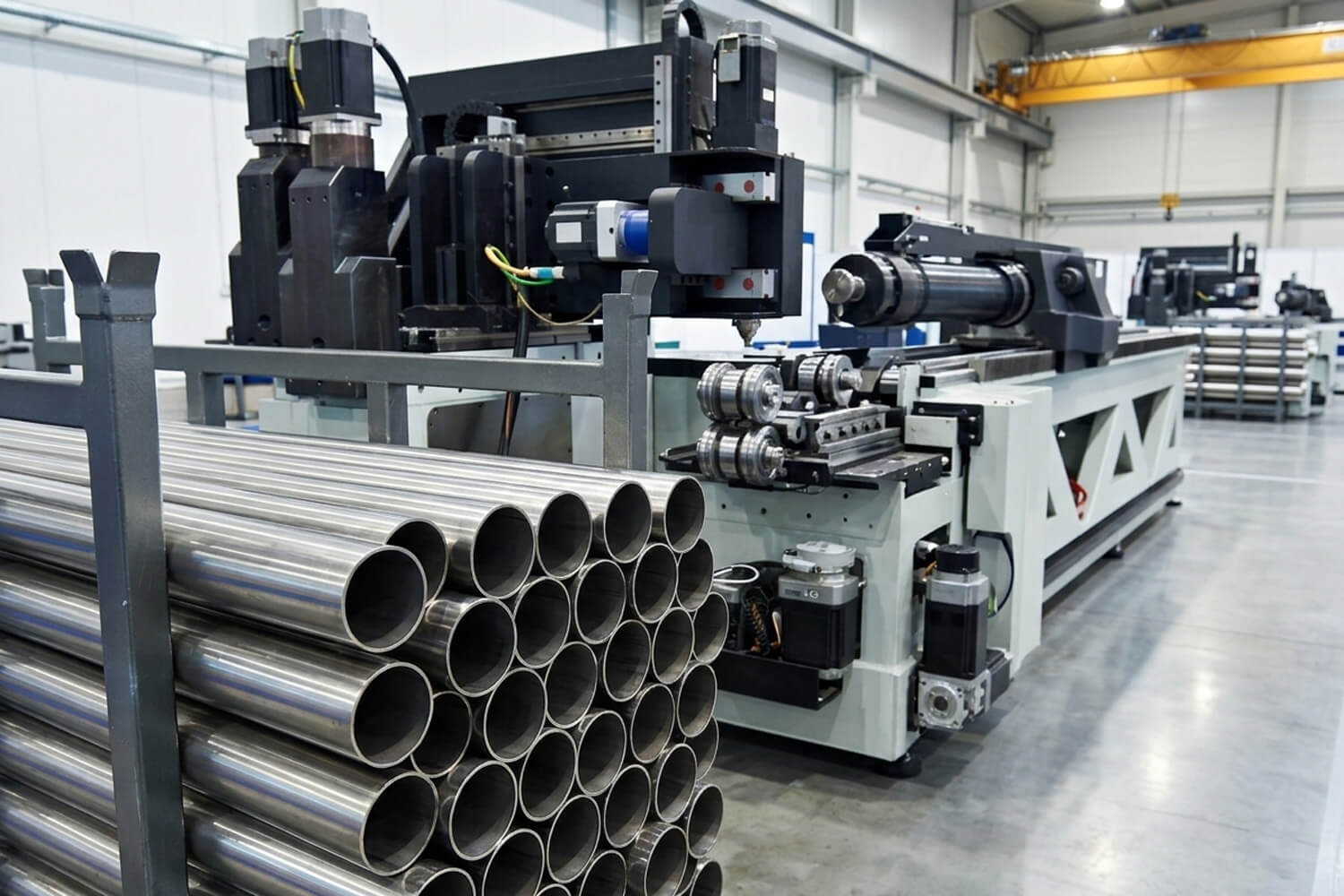
- Mandrel bending supports the inside of the tube during the bend. It's the standard choice for tight radii and thin walls, because it prevents wrinkling and flattening.
- Rotary draw bending produces accurate, repeatable bends and is widely used in automotive work.
- Roll bending suits large-radius curves.
- CNC bending adds repeatability across high-volume production.
For exhaust and fuel lines, mandrel-supported rotary draw bending is the usual answer, because it holds the round cross-section through the bend.
Inspection and Testing
Precision only counts if it's verified. Good practice includes:
- Dimensional inspection of bend angles, radii, and lengths. Non-contact 3D measuring checks the whole part shape against the drawing without touching or deforming the tube.
- Pressure testing and leak inspection for fluid-carrying assemblies.
- Visual inspection for wrinkles, kinks, and surface damage.
What to Look for in a Bending Supplier
For automotive parts, look for a supplier that:
- Can bend the diameters you need, for example exhaust piping and smaller-diameter fluid lines
- Has mandrel bending capability for tight radii and thin-wall tube
- Offers the secondary operations you need, such as cutting, end forming, and welding
- Inspects with measurement equipment suited to complex 3D geometry
- Supports both prototype quantities and full production
Key Takeaways
Bend quality directly affects how well a vehicle's tubing works and how safe it is. Smooth, accurate bends improve flow, fit, and durability, and reduce leak points. To get those results, specify the tolerances that matter, choose a method suited to the tube and radius, and confirm the finished parts by inspection and testing.
Need bent exhaust or fuel line components? Pipe Processing TI has more than 75 years of bending and fabrication experience.
Share it!