May 1, 2023
Top 5 Pipe Bending Methods

Team Pipe Processing
*Updated on January, 2025, to include the latest insights.
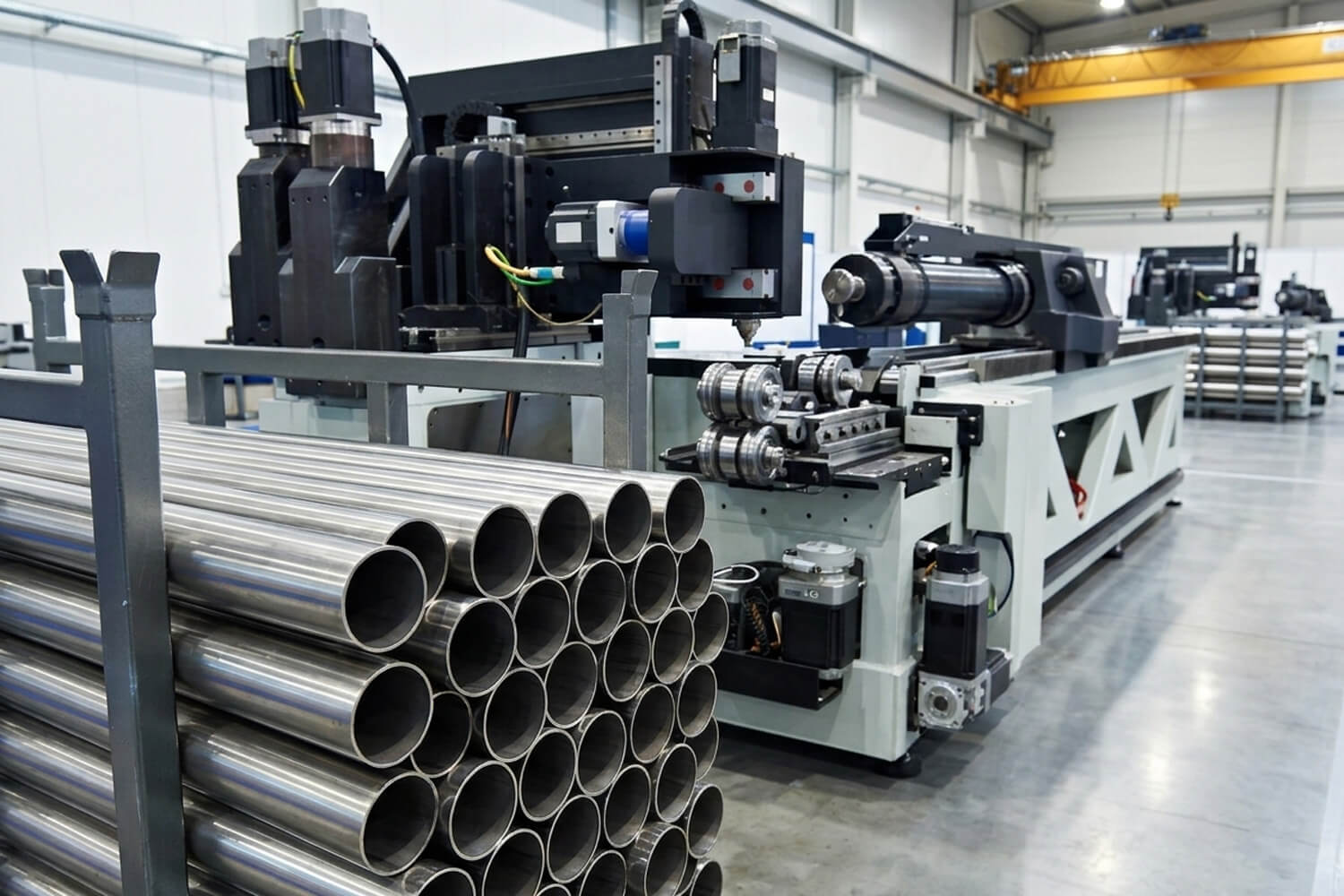
Pipes are an essential component of many industries, and they come in different shapes and sizes. When it comes to joining materials together, pipe and tube bending is recognized to be less expensive than welding in the metal and plastic industries. For a variety of uses, it is the process of permanently molding metal or plastic pipes. In this method, mechanical force is used to bend pipe or tubing into the shape of a die.
What Is Pipe Bending?
Pipe bending is a metal forming process that uses mechanical force to permanently shape pipe or tube into a curve, without cutting and welding separate sections together. A bending die establishes the bend radius while the tooling controls how the material stretches on the outside of the bend and compresses on the inside — the balance that determines whether a bend comes out smooth or wrinkled, kinked, or flattened.
Because a single bent pipe replaces multiple welded joints, bending produces stronger, lighter assemblies with fewer potential leak points, and it is typically faster and less expensive than fabricating the same geometry from welded segments. It is used across automotive exhaust and fuel systems, hydraulic lines for heavy equipment, aerospace tubing, agricultural implements, HVAC, and structural applications such as roll bars and handrails.
The right pipe bending method depends on four factors: material and wall thickness, required bend radius, dimensional tolerance, and production volume. The five methods below each handle those variables differently.
Importance of choosing the right pipe bending method
Having the proper tools is essential for tube bending. Your efforts to bend tubes will be both effective and efficient to a large extent depending on the equipment and tools you employ. Working in a fabrication shop implies that you don't have time to goof around, which also means that you don't have time to wait for the right tools. Take into account the material you are working with, the accuracy you will need to achieve, and the required output quantity. Once taken into account, these elements will directly influence your choice of tube or pipe-bending solutions.
There are several methods for bending pipes, each with its advantages and disadvantages. The top 5 pipe-bending methods include:
• Mandrel bending
• Rotary draw bending
• Roll bending
• Heat induction bending
• Compression Bending
*Other Pipe Bending Methods are here.
Now let us understand each one of the pipe bending methods in detail:
Mandrel bending is a pipe bending method that involves inserting a mandrel, or a flexible rod, inside the pipe to prevent it from collapsing during the bending process. The mandrel supports the pipe's interior, allowing for tight radius bends without deformation. Mandrel bending is commonly used in the exhaust and plumbing industries.
Pulling the tube over a mandrel that is being held in a fixed position is the first step in mandrel pipe bending. The inner radius of the bend is supported by the force acting on the mandrel tip as the pipe is bent, keeping it firmly in the bend dies groove.
Rotary draw bending is a precise pipe bending method that produces high-quality bends. It involves clamping the pipe at one end and rotating it around a die while a mandrel supports the pipe's interior to prevent deformation. The process results in smooth bends with no wrinkles, kinks, or flat spots. Rotary draw bending is commonly used in the automotive, aerospace, and plumbing industries, among others.
As mandrels and dies are used inside the tube, rotary draw bending gives you more control over the tube-bending operation. With the help of this control, we can bend very tightly and create minor dimensional tolerances. This technique has additional advantages, such as a smooth, aesthetically attractive appearance, which makes it perfect for situations where bend cosmetics are crucial. Square and rectangular tubes, pipelines, channels, and extruded shapes can all be bent using rotary draw bending.
3. Roll Bending
Roll bending is another pipe bending method that involves bending a pipe around a set of rollers. The rollers apply pressure to the pipe, causing it to curve. Roll bending can produce large-radius bends with a smooth finish, making it ideal for architectural applications. However, it is not suitable for tight radius bends or thin-walled pipes.
Modern digital roll-benders have a screen where the operator can examine measurements and data in addition to its hydraulic operation. Additionally, tubes can be subjected to manual or automatic operations. Both the roller distance and the speed of the shafts can be altered.
4. Hot Induction Bending
Hot induction bending is a pipe bending method that involves heating a section of the pipe to a high temperature and bending it to the desired angle. The process uses an induction coil to heat the pipe and then applies pressure to bend it. Hot induction bending can produce tight radius bends and is commonly used in the oil and gas industry.
The principle of induction is used in induction bending to locally heat a pipe. As a result, the pipe develops a small heat band. As the pipe is pressed by a precise driving system in a hefty frame, the heated material is bent in a constrained area. The bent shape is then formed by cooling the bent section with water or air. The bending procedure is automatic and continuous.
Compression bending is a pipe bending method that involves compressing the pipe between two dies to create a bend. It is a cost-effective method and is commonly used for large-radius bends. However, the process can cause some deformation of the pipe, and it is not suitable for thin-walled pipes.
This technique can create bends with a short radius and is frequently used for pipes of small diameter. Compression bending can be carried out manually or with the use of specialized equipment like hydraulic presses or compression benders. Compression bending has the benefit of not requiring a mandrel or special tools, which makes it an affordable choice for performing straightforward bends. However, it might not be appropriate for pipes with thicker walls or greater diameters, which might need additional bending techniques to prevent collapsing or wrinkling.

Other Pipe Bending Methods
Beyond the five methods above, several specialized techniques serve narrower applications. These are worth knowing when standard bending approaches don't suit the material, diameter, or tolerance requirements of a part.
Press bending is the simplest and fastest bending method. The pipe is held at two fixed points while a hydraulic ram forces a bending die against its midpoint, pressing the material into shape. Unlike compression bending, which wraps the pipe around a stationary die, ram bending pushes the die into the pipe from the outside.
The tooling is inexpensive and the cycle time is short, which makes press bending well suited to thick-walled pipe, conduit, structural frames, and railings. The tradeoff is deformation: the outer wall thins and the cross-section tends to flatten or oval at the bend, so press bending is not used where dimensional accuracy, tight radii, or cosmetic appearance matter.
In stretch bending, the pipe is gripped at both ends, pulled into tension, and then formed around a bend die while tension is maintained throughout. Holding the material in tension reduces springback and distributes stress more evenly, producing smooth, large-radius curves with consistent cross-sections and minimal surface distortion.
Stretch bending is common in aerospace, rail, transit, and architectural applications where contour accuracy and finish quality are critical. It is slower than other methods and requires more expensive tooling and higher-capacity equipment, so it is generally reserved for parts where repeatability and appearance justify the cost.
Hot Slab Bending (Sand Packing)
Hot slab bending is a traditional method used for large-diameter, heavy-wall pipe. The pipe is packed with sand to support the interior, heated to forming temperature, and bent against a fixed form or slab table. The sand prevents the walls from collapsing while the heated material is shaped.
The method handles diameters and wall thicknesses that exceed the capacity of most powered bending equipment, and it remains in use for pipeline, shipbuilding, and heavy industrial work. It is labor-intensive and slow, with less dimensional consistency than induction bending, which has largely replaced it for high-volume production.
Freeform and Three-Roll Push Bending
Freeform bending uses a movable bending die that shifts position as the pipe is pushed through it, allowing the bend radius to change continuously along a single part. This makes it possible to produce complex, variable-radius geometries — spirals, S-curves, and transitions — in one operation, without changing tooling.
The method is used in automotive exhaust and chassis work and in furniture and design applications where organic curves are required. Setup is CNC-controlled and highly flexible, but the equipment investment is significant and the process is less suited to the tight, fixed radii that rotary draw bending handles well.
Choosing Beyond the Standard Methods
These specialized methods generally come into play at the extremes: very large diameters, unusually thick walls, variable-radius geometry, or finish requirements that standard tooling cannot meet. For most production work in automotive, heavy equipment, and agricultural manufacturing, mandrel and rotary draw bending remain the practical choice — they deliver the tightest radii and closest tolerances at production volumes.
Futuristic Approach to Pipe Bending
Recent years have seen substantial progress in pipe-bending technology, and numerous upcoming advances have the potential to completely transform the sector. Automation technology and improvements in CAD software could result in more accurate and effective bending procedures. Also, the development of complicated, specialized pipe bending tools could be made possible by the use of 3D printing technology, providing more precise and economical bending solutions.
New pipe materials that can be bent differently than conventional metal pipes, such as carbon fiber composites, may be stronger, lighter, and more flexible in the future. Robotics and artificial intelligence (AI) could also be used to bend pipes more quickly and precisely while using less labor overall.
Conclusion
To sum up, we’d say, pipe bending is an essential part of many industries, and there are several pipe bending methods available. Each method has its unique benefits and limitations, and choosing the right method depends on factors such as the pipe's size, wall thickness, and desired bend radius. Understanding the different pipe bending methods can help you choose the best method for your application, resulting in high-quality bends that meet your requirements. So choose wisely before making up your mind.
Share it!
PIPE PROCESSING TECHNICAL INSTITUTE
Streamline Your Pipe Processing Challenges
Streamline Your Pipe Processing Challenges
Struggling with customization complexity, tight deadlines, or rising costs? We deliver:
- Precision bending for custom designs
- Fast turnarounds for tight schedules
- Cost-effective solutions for any scale
Partner with Pipe Processing Technical Institute to streamline your production and overcome challenges with ease.